
Process optimization
Process optimization involves improving industrial and manufacturing processes to enhance efficiency, productivity, and output quality while minimizing waste, operational costs, and environmental impact. By analyzing machine behavior, operational parameters, and process conditions, organizations can stabilize production and ensure predictable and reliable performance.
Through high-quality vibration data, smart analytics, and targeted process adjustments, process optimization enables operators to make informed decisions that support consistent, cost-effective, and sustainable production.
What is process optimization?
Industrial process optimization involves understanding the process parameters and operational conditions of machines and how they interact, then using data-driven insights to enhance performance. Typical objectives include:
Increased efficiency and throughput
Reduced operational costs, including energy, raw materials, and labor
Improved product quality and consistency
Minimized waste and environmental footprint
Enhanced reliability and reduced downtime
Modern process optimization relies on continuous data collection, advanced algorithms, and real-time visualization. By identifying patterns, detecting deviations, and quantifying the relationship between machine behavior and process outcomes, operators can adjust process parameters to ensure optimal performance.
In capital-intensive industries, stable processes require reliable equipment. This makes process optimization closely linked to machine health: effective optimization builds upon accurate insights into how assets behave under varying loads and operating conditions.
Benefits of industrial process optimization
A structured approach to process optimization delivers measurable improvements across the production chain:
Higher throughput and production stability
Reduced process variability and improved product quality
Lower energy consumption and more efficient use of raw materials
Fewer bottlenecks and reduced unplanned disruptions
Stronger alignment between equipment condition and process performance
Improved cost control and long-term operational sustainability
By continuously refining how machines operate and how processes respond, organizations gain better control over production dynamics, enabling safer, more predictable, and more profitable operations.
SPM Instrument’s approach to industrial process optimization
With over fifty years of innovation in high-performance condition monitoring, we help industries improve production efficiency with high-definition data from our patented HD Technologies to optimize key processes.
HD ENV and SPM HD technologies deliver high-quality data, providing deeper insights into industrial processes. By monitoring and analyzing emerging data patterns, our solutions reveal changes and behaviours related to critical process conditions.
Our proven measurement technologies, intelligent algorithms, and robust hardware enable process industries to identify and improve previously unexplored areas of their production.
Profitability by combining condition monitoring and process optimization
Process optimization for high-resolution process data ties in perfectly with condition monitoring. Combining condition-based maintenance with optimization is a winning strategy. This approach contributes to:
Increased production speed
Increased raw material yields
Maximized availability
Enhanced plant condition
Health, safety, and environmental improvements
A well-designed and well-implemented condition monitoring program, paired with successful process optimization, unlocks the full potential of both assets and production, enabling plants and operations to capitalize on new opportunities for increased profitability and growth.

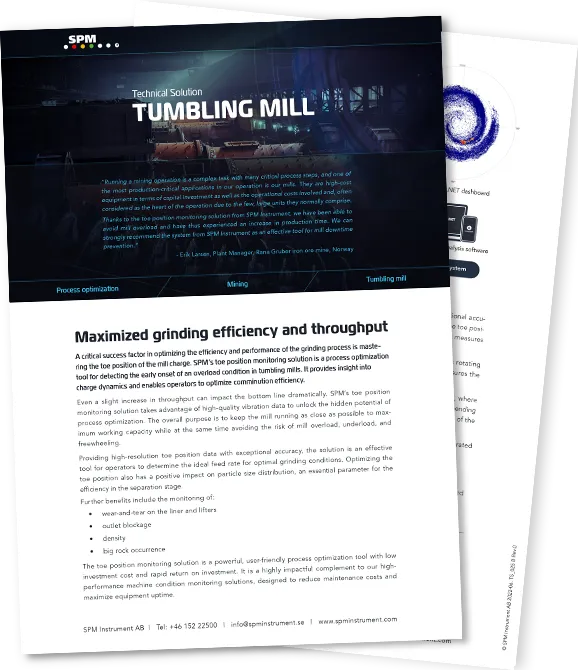
Solution to optimize tumbling mill grinding processes
The process optimization solution monitors the charge toe position at the inlet and discharge ends of the mill drum. It is an effective tool for operators to determine the ideal feed rate for optimal grinding efficiency and particle size distribution.
In addition to avoiding mill overload, underload, and freewheeling, further benefits include monitoring:
- Wear-and-tear on the liner and lifters
- Outlet blockage
- Density
- Big rock occurrence

Vibrating screen performance monitoring
For optimal screening performance, uniform movement of the screen corners is crucial. Our screen performance monitoring solution is a process optimization tool for visualizing screen motion.
The solution detects unfavorable screening conditions that can cause various problems, including
- plugging and blinding
- mechanical stress
- overload
- screen media wear
- excessive energy consumption
- process capacity losses.
SPM’s screen performance monitoring solution helps determine if the screen performs at full capacity and is an excellent aid to maintenance and production.


Process optimization for wood chippers
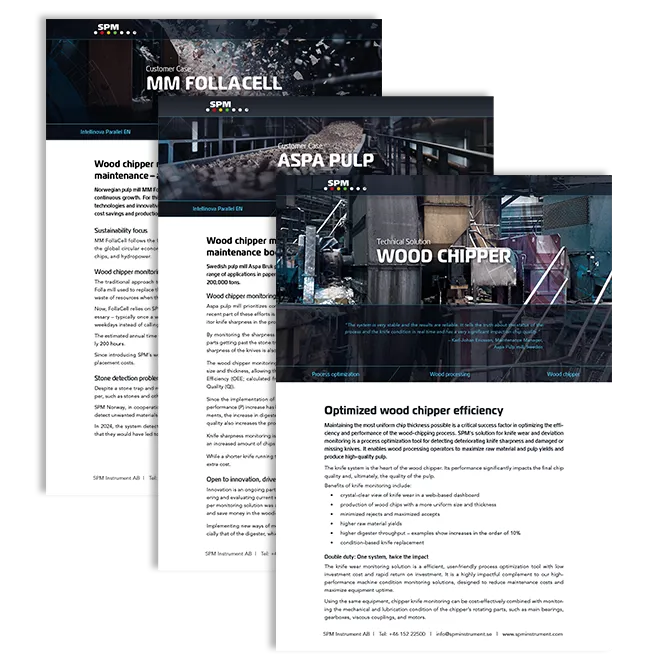
Our knife wear monitoring solution provides valuable insights into the condition of wood chipper knives. Through the Condmaster.NET dashboard, users can analyze performance data to manage knife replacement proactively. Graphs clearly indicate if a knife is damaged, dull, detached, or missing from the holder. The result? More consistent chip size and thickness, reduced reject rates, improved raw material yields, and increased throughput.
Process optimization for centrifugal pumps
Pumps account for a significant part of the world's energy consumption. Based on SPM’s patented HD technology, this innovative solution can boost energy efficiency, extend the service life, and dramatically enhance the overall operating economy of this widely used industrial equipment.